Earlier this year, I had the special privilege of spending a week teaching the class of 2026. During this time I got to know each of them a little more and began discussing their set books with them. During my week of instruction, I introduced them to some basic decorative leather dyeing techniques and embroidery on leather. A month later, when visiting Boston again, I checked in to see how their set book designs were progressing. So it was extra exciting to interview this class as I couldn’t wait to see how their ideas evolved and were finally realized in leather.

The selected text for this year is Slaughterhouse-Five, or, The Children’s Crusade: A Duty-Dance with Death by Kurt Vonnegut, Jr. Originally published in 1969, the students bound a recent letterpress edition from Suntup Editions, which includes full color illustrations from Julian De Narvaez. Slaughterhouse-Five may be Vonnegut’s most popular novel. In fact, many of the students were already familiar with the text, having read it in either high school or college. Described as a semi-autobiographical, science-fiction, anti-war novel, it follows the experiences of Billy Pilgrim traveling back and forth through time with a focus on his capture by the German Army during World War II. Since Slaughterhouse-Five is quite an impactful story generating lots of emotion, many of the students felt compelled to use this as an asset while formulating their designs.
The class of 2026 is presenting quite an impressive collection of bindings that showcase a range of traditional decorative techniques. A few students continued exploring leather dyeing and others used printmaking to amplify their designs. I was impressed by everyone’s thoughtful approach to their design and investigation of technique. Many students relayed how supportive they felt by their classmates from the presentation of their ideas through to the completion of their bindings.
The set books will be on display at North Bennet Street School (NBSS) for the 2026 Exhibition: Disciplines Across Decades through July 3rd. This year’s exhibit showcases the origins and history of the school’s nine career-training programs. This will be done by highlighting how students are trained through the use of artifacts and works by both students and graduates.
Willa Anderson
@wanderso.books
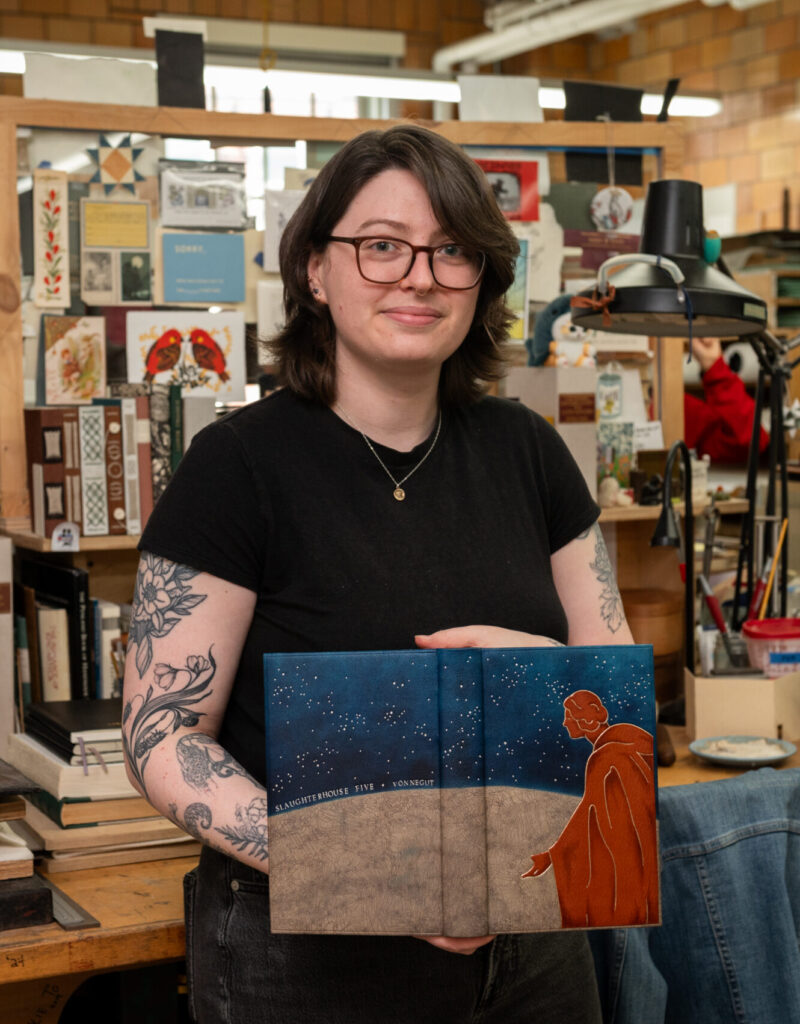
Reading through the text for the first time, Willa found Slaughterhouse-Five to be quite a moving and impactful story with both dark and satirical elements. With so much striking visual inspiration within the text, Willa mulled over several different design ideas before landing on the one that left the greatest impression on them. Vonnegut compares the destruction of a bombed-out Dresden as being like the surface of the moon: bleak and lifeless. The figure on the front cover is pulled from the iconic 1945 black-and-white photograph by Richard Peter depicting the Martin Luther Monument atop city hall. Peter scaled the building to capture the devastation of Dresden that took place in the final months of World War II. The angle appears as if from the point of view of the statue itself.

Before landing on the final strategy for creating the moon in space, Willa tested a range of options which included using a scarf joint or Frisket film. In the end, they very carefully and expertly dyed a single piece of leather without a masking film. The top half was dyed using four different shades of blue, all hand-mixed using aniline powders and applied to capture the tonal differences of space. Once the blue dye had fully dried it was then sealed with a dye fix which allowed Willa to move forward with the base of the moon, also an aniline dye. The texture of the moon was created through the craquelle technique using two shades of grey spirit dye. While testing, Willa found they could get the most control at cracking fine lines by applying two thin layers of flash-cooked paste. And the lines were achieved by cracking the leather over a finial at the top of a nipping press. After washing off the paste to reveal the fine lines, a happy accident occurred: a slight glow appeared at the edge of the moon.

The aforementioned statue from that famous photograph appears on the front cover as a tooled chestnut goatskin onlay. The outline of the figure along with interior details are tooled using moon gold and a series of gouges, line palettes and a blender set. Willa spoke about how they really enjoyed the challenge of creating the tooling template for the statue within the limitations of the tools. It’s a puzzle that you have to invent. In between the tooling stages, Willa added shadows to the statue by hand-painting diluted brown spirit dye with a Q-tip.

A scattering of stars were tooled spontaneously across the blue dyed region of the design using a range of dot and period tools in palladium. The stars are arranged both sparsely and in clusters across space to provide a more realistic effect. The endbands are sewn around a rectangular core using three shades of blue. The head edge is decorated with a graphite base and the same tooling pattern of stars were gauffered with silver foil. The same dyeing and tooling steps were taken to create the edge-to-edge leather doublures to mimic the same effect as the front cover. However, the dye application is purposefully lighter to create a calmer transition from the outside. This feeling of tranquility continues with the lighter blue paste paper flyleaves, which Willa created by applying dark blue and iridescent paint on light blue Bugra.

During undergrad, Willa studied printmaking at the Rhode Island School of Design before moving to Boston to pursue a Master of Library and Information Science degree at Simmons University. It was at Simmons, where Willa was introduced to NBSS through a course that is held at the school. After applying to the program pre-pandemic, Willa deferred and worked as a cataloger. Eventually they reconnected with NBSS and entered the program. Beginning in September, Willa will start a year-long fellowship at the Boston Athenaeum, which is funded by the Von Clemm & Driscoll Family. I was completely wowed by Willa’s binding and their spirited approach to investigation and exploration of technique. They really hit the ground running with the basic instruction I gave them on leather dyeing and managed to perfect it for their binding. Willa crafted a bold and striking design that provides just enough intrigue for the viewer, yet is even more meaningful for those familiar with the text.

Hanna Rashidi
@rashidiart
As a first time reading through Slaughterhouse-Five, Hanna recounted how varying her emotions were and hoped to achieve a design that would fully express the core concepts of the text. Yet how do you visualize lofty concepts such as the infinite scale of time and space or how one’s mind can get lost comprehending the blurred lines between the arbitrary and the chaotic? Wanting to work within the confines of the book structure, Hanna landed on a fractured design reminiscent of a cracked mirror. The aesthetic is moody and haunting and the more I spoke with Hanna, the more details were unearthed.

To my surprise, the inlaid panels are a single piece of calfskin, delicately dyed to create a faceted effect that visually splits each piece into three sections. Hanna chose a tombstone shape for the inlays as a nod to the design of the first edition. Working on an oversized piece of leather, Hanna first masked out the division in order to dye the center portion first with hand-mixed aniline dyes. Using a cotton ball as an applicator, Hanna blended blues, greens, browns and blacks to create a foggy effect of lights and darks. Sealing this area with dye fix created an unexpected, but welcoming texture to the surface. The dividing lines of the dye inlaid extend beyond the edge with blind tooling to create a large letter V as both a nod to the number five and Vonnegut. A subtle, yet satisfying detail for the most attentive onlooker. The title is tooled in palladium on a hand-dyed label on the spine, which mimics the center portion of the inlay. You can find the author’s name near the tail edge on the back cover, with the blind tooled lines filling in the for V in Vonnegut.
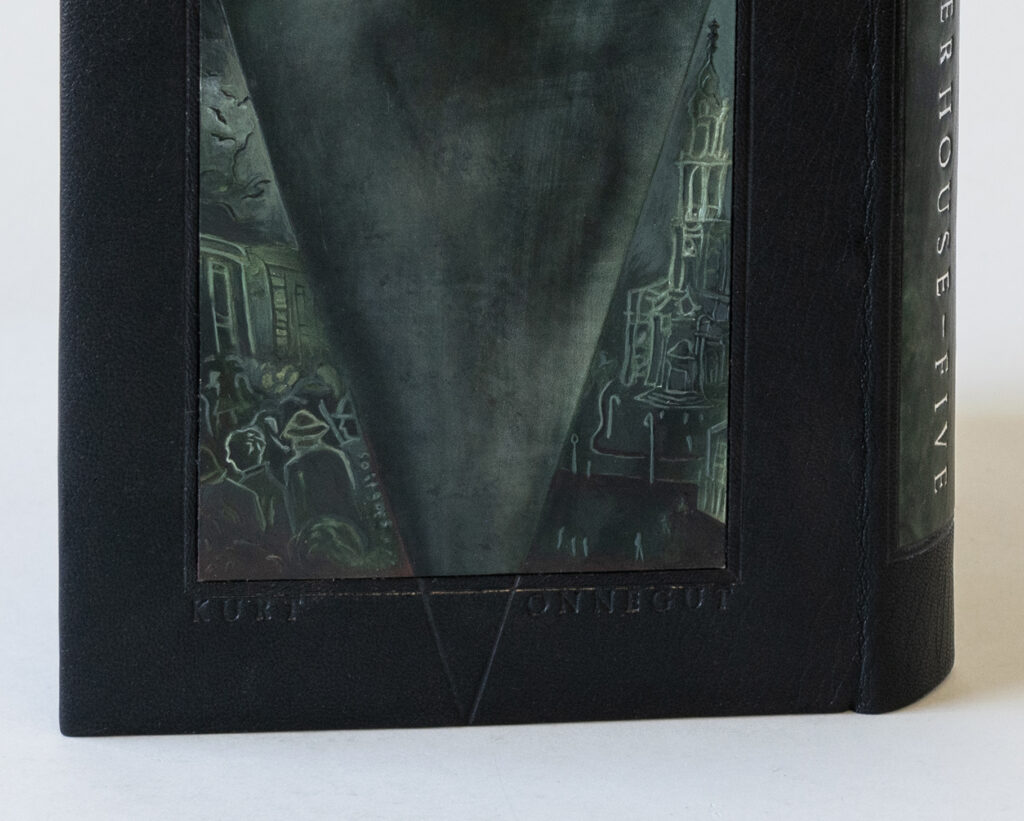
After several rounds of layering the dye for the center portion, Hanna swapped the frisket mask in order to add the scenes to the left and right through the use of linocuts. Each linocut illustration denotes a significant scene from the text. The right side of each panel depicts Dresden before (back) and after the city was bombed (front). While on the left side (front cover), we peer into the first time we see Billy outside of war, he and two other soldiers are walking in a snow covered forest the moment before being captured by the opposition. The tranquility and vastness of this scene is juxtaposed to the claustrophobic and chaotic scenario Billy finds himself later in the text as he is being crammed into a train car departing for a POW camp (left back cover). To create these vignettes, Hanna dampened the leather in order to leave an impression with the linocut plate. Contrast was added to each scene with hand-painted highlights in gouache.

The endbands are a single rectangular core sewn on with silk threads in black and two tones of red. This section of red perfectly aligns to the red stripe running along all three edges of the text block. Using gouache, Hanna blended the colors to create a soft red-orange glow along the pages that covers the bombing of Dresden. When opening the binding, softer hues of grey slowly span across the paste down and onto the fly leaf, creating a fluid transition away from the heavy imagery on the cover. This effect was achieved with a custom made paste paper on black Ingres.

Hanna was working at the San Francisco Center for the Book, first as a volunteer and then as a Workshop Instructor. It was at SFCB, that Hanna learned about the program at NBSS and determined it was the exact place for her to hone her skills further and to learn techniques through a historical lens. Hanna will be spending the summer as a Conservation Intern at the Boston Public Library. She’ll also be teaching public workshops at the Museum of Fine Arts in Boston and the Fuller Craft Museum in Brockton. After her internship, Hanna’s goal is to find a part-time conservation position so that she can also focus on teaching, crafting fine bindings and taking in commissions. After speaking with Hanna, I really appreciated the ambition behind her design. She set out with the towering goal of incorporating a wide range of emotion within her design and was able to do so in both dynamic and subtle ways. I could tell through our conversation that each element was carefully calculated to have both meaning and harmony within the design.

Alison Schaefer
@schaefsters
Alison read Slaughterhouse-Five in high school and really loved it, so reading it again for this project was a welcoming task. Even though she considered a range of ideas, which all had their own unique technical challenges, Alison landed on a design that references the first chapter of the text. In this introductory chapter, Vonnegut describes how he outlined his non-linear narrative on a roll of wallpaper using crayons. Each character was assigned a different color, with their journey illustrated as a single line to denote their progression through the story. Eventually, some of the lines enter into a zone of orange cross-hatching representing the bombing of Dresden.

Alison’s binding is covered in a terracotta goatskin and adorned with lots of gold tooling. Each line was purposefully placed across the binding and spaced to allow for the title and author at the spine. Each line was marked initially at the fore edge and then connected to the other side ending with a tooled onlay. Each line was tooled with a layer of red gold before attaching a small leather onlay in either scarlet red, yellow, grass green or bright blue goatskin. Each line was then tooled with another layer of leaf along with the onlays. Alison landed on surface gilding as the appropriate technique to reference the cross-hatching pattern. Surface gilding provided a finish that both evokes an explosion while also creating a murky barrier that only one character manages to pass.

Testing techniques for one design idea after another not only helped Alison land on the design you see here, but it also solidified her desire to create a design that would focus primarily on tooling. Not everyone finds joy in the complexities of tooling, but for Alison it just always made sense to her. Alison tied the head edge decoration to the cover by applying a base of Armenian boule, a lovely red-orange pigment very similar to the terracotta goatskin, which was then sprinkled over with red gold leaf to mirror the effect of the cloudy surface gilding. French double-core endbands were sewn with stripes of red, gold and blue threads.

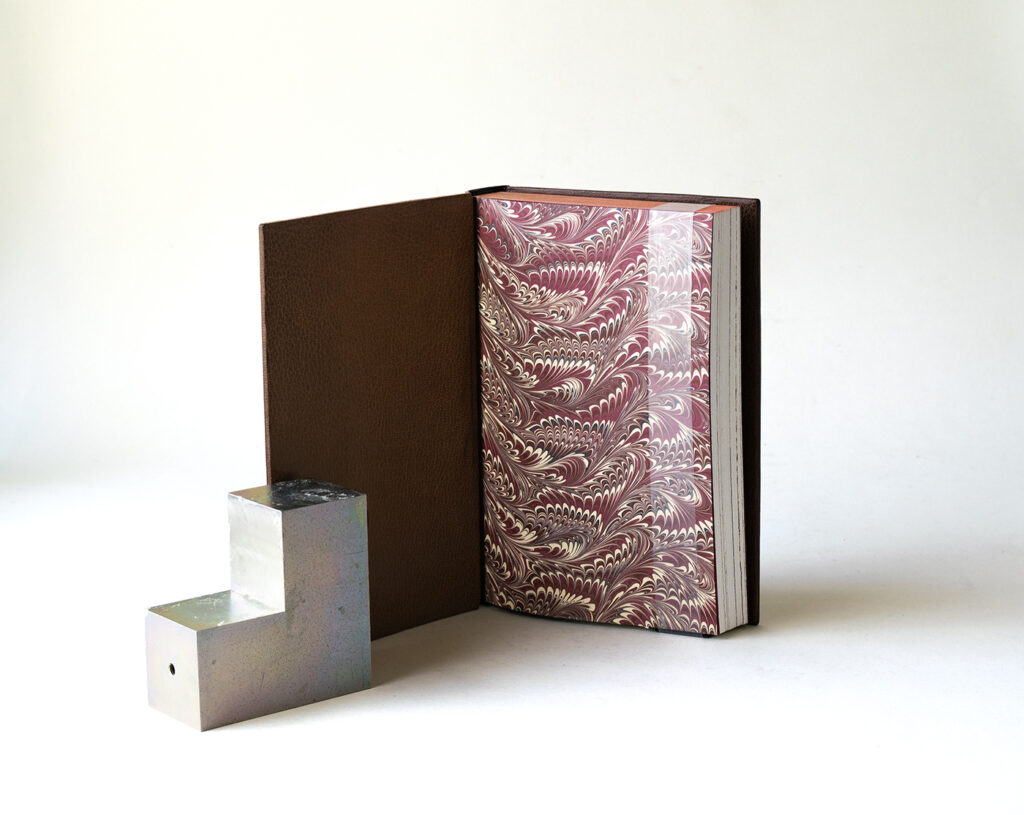
While Alison didn’t have a specific paper in mind for the paste down and fly leaf, she had a few options to consider. To reflect the first chapter, Alison considered a floral pattern to mimic the aforementioned wallpaper. In the end, she steered towards a marbled paper that matched the colors of the tooled onlays perfectly. Plus the characteristics of the marbling, give off other-worldly vibes that nod to the science fiction aspects of the text and a perfect juxtaposition to the linear design on the cover.

Before coming to NBSS, Alison worked as a sound technician at a local theater. Wanting a career change, Alison found her new direction while waiting for the train. An ad for the school led her to investigate the different training programs and while she contemplated a couple of the programs, her interest in conservation directed her to apply to the Bookbinding program. Alison will be a Book Conservation Intern over the summer at the Northeast Document Conservation Center. Planning for her future beyond the summer, Alison hopes to work in conservation while also making time for binding work. She definitely wants to continue tooling, a skill she greatly enjoys doing. I can appreciate that Alison went with her intuition and selected a design that played to both her interests and skills. It resulted in a simple yet highly technical design that is both harmonious and effective. I love the frantic energy of the marbled paper interior, it perfectly balances with the precision of her design on the cover.

Rachel Schlow
After reading through Slaughterhouse-Five for at least the second time, Rachel considered how she could compose a modern design that would be both bold and graphic through the use of traditional techniques, such as tooling and onlays. In Chapter 2, we find the protagonist, Billy, as a chaplain’s assistant in South Carolina. Here, he is in charge of a portable altar and small organ that has thirty-nine keys and two stops, the latter are commonly known as vox humana and vox celeste. Vonnegut used this pair of terms to represent earthly suffering (vox humana) and the divine (vox celeste). And Rachel used them along with the classic, yet wild sci-fi paperbacks from the 1960s and 70s to inspire her striking and eye-catching design.

Rachel’s binding is covered in a medium brown goatskin with two realistic hands reaching out from their perspective planes set against simple backdrops. To create the perfect gestures, Rachel reached out to several men in her life for photographs of their hands. After selecting the perfect poses, each hand was turned into line art for the purpose of tooling. Rather than working with existing tools, Rachel crafted 3 flat elliptical finishing tools in order to stylize the hands in her vision. The hand on the front cover is adorned with a cherry goatskin onlay tooled in red gold leaf and is rising from the earth to represent the anguish of humankind. The celestial hand reaching down from the heavens is gently extending an open palm toward the ground and is adorned with a lime green goatskin onlay tooled with moon gold leaf. Rachel cleverly arranged the life lines in the palm to create an eye looking downward.

Rachel worked out the design directly on the book in both a structured and spontaneous manner. A template was required in order to achieve the detail of each hand, but Rachel worked more free form to balance out the rest of the design. Each hand is anchored with a simple background to strengthen each side of the theme. Jagged lines applied through carbon tooling aggressively cut across the lower half of the cover. To balance this effect, a soft sprinkling of tooled stars are peppered across the upper half in moon gold. The main portion of the title is carbon tooled while the lengthy subtitle was blind tooled across the spine. This small difference creates a bold effect for the title. The author’s name is also blind tooled and is encased in the carbon tooled bramble near the tail.

Endbands are sewn in an asymmetrical pattern around a rectangular core with threads in orange-brown, red brown and bright green. The same shade of green used on the celestial hand can be found adorning the head edge of the text block. Creating the perfect color and texture for the edge decoration was quite a roller coaster as Rachel experimented with acrylic paint first before switching to ink. On the interior side of the cover board, we are welcomed by the same shade of green as a sunken suede panel surrounded by a border of lime green and medium brown goatskin. The outer border has been further adorned with tooling. The interior is finished with an Italian marbled paper that feels like an aerial view showcasing the surface of another world.

Rachel was first introduced to NBSS by a friend who was enrolled in the Jewelry Making and Repair program. Even though she had never bound a book before, she was engrossed by the Bookbinding program and decided to take a Community Education workshop with Amy Lapidow before applying. Even though she was not accepted during this first round, she spent the following year building additional hand skills by learning how to crochet. With this addition in her portfolio, she was accepted the following year. Prior to graduation, Rachel began acquiring equipment and tools in order to set up her own private practice. In her practice, she wants to continue crafting design bindings and take on commissions, while also crafting a line of products and hand tools. I think Rachel was super successful in creating a vivid design with her binding. Hands are notoriously difficult to illustrate and to achieve such realism with gold tooling is highly commendable. Her use of realistic imagery and bright colors certainly makes her binding captivating and inviting.
Carmen Torrado Gonzalez
@carmen__adriana__
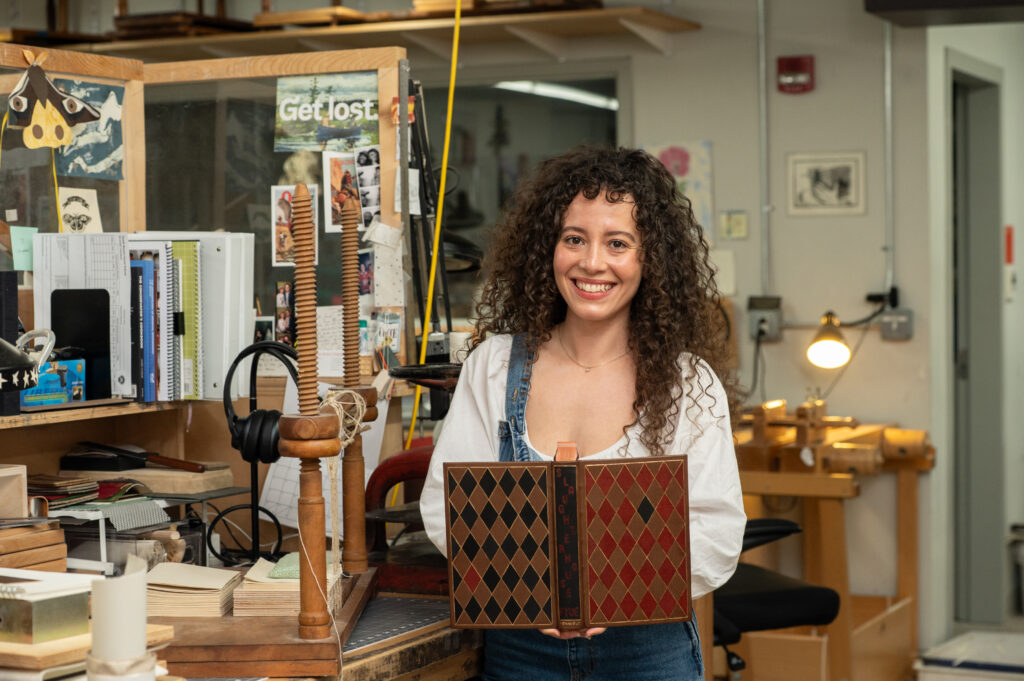
Re-reading Slaughterhouse-Five for this project, Carmen immediately leaned into the comforting color palette found in the illustrations from this particular edition. Landing on the design, however, was a bit more challenging. Carmen waffled between text heavy designs to more illustrative scenes. She finally reached towards a traditional design that could be easily modernized. After learning about tooling at Rare Book School the summer before her second year, Carmen knew she wanted to incorporate lots of tooling on her set book. While learning how to tool at the start of the second year, she learned about the diaper pattern. Even though this pattern may date back as far as the 13th century, its popularity rose again in the 19th century and continues to challenge bookbinders and finishers to this day.
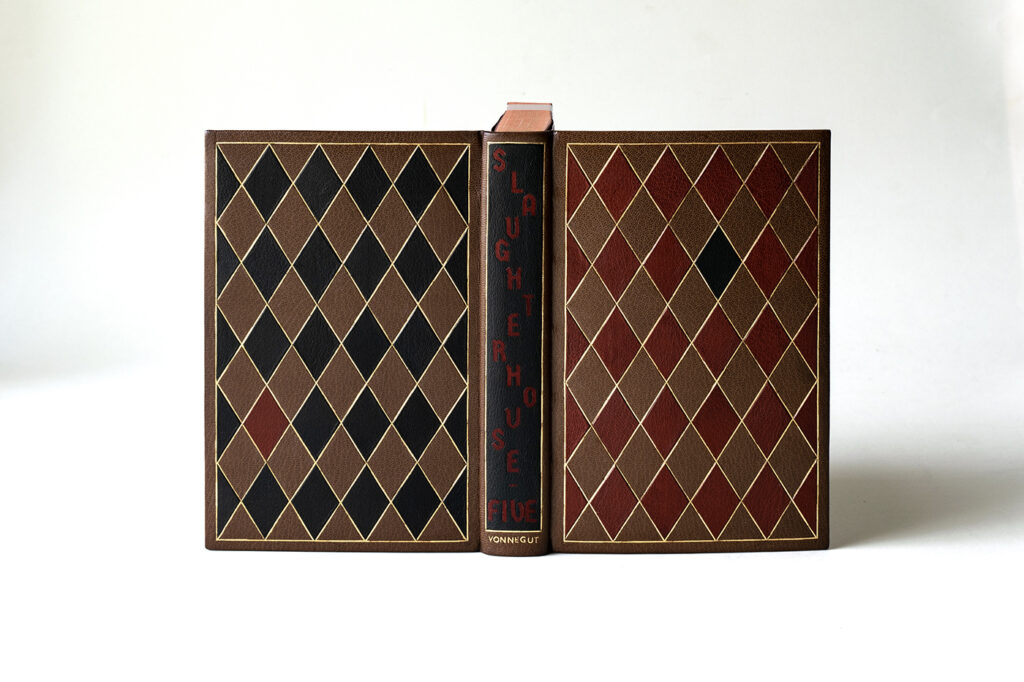
The binding is covered in a dark medium brown goatskin with tooled onlays in cherry red and black goatskin. Laying out a perfect diaper pattern requires lots of precision and exactitude. To set herself up for success, Carmen tested different measurements on paper again and again until finding the right size. However, a direct transfer from a paper pattern does not always guarantee an even layout. To combat this, Carmen marked the layout for each cover using dividers. While laying down each line, Carmen found the thickness of the tool was something that required careful consideration and slight adjustments to maintain an even pattern. The entire pattern is tooled in red gold and framed by a single line border.

I asked Carmen if she detested the diaper pattern after working on this binding and to my surprise she said the opposite. She’s still enamored by the design and looks forward to more tooling challenges in the future. One design element Carmen wanted to include from the beginning was to use back-pared onlays for the title. Each letter was hand-cut in a simplified version of the typeface seen on the title page. The onlays were cut from the same cherry red goatskin and back-pared on a black goatskin title piece. The author’s name is tooled at the tail of the spine in red gold to match.

The endbands are sewn in black silk around a rectangular core. For the head edge, Carmen created an explosive look by employing a sprinkled edge. The leaf is more dense at the spine and then become more sparse as it progresses towards the fore edge. The interior side of the board is covered in a matching edge-to-edge leather doublure and is paired with a marbled paper that Carmen made during a workshop with Chena River.
Carmen also found out about NBSS through a friend who noted she may be interested in the Bookbinding program based on her background. Carmen’s experiences range from poetry to chemistry to marketing. As she investigated a career in conservation, she landed on NBSS as the best option to develop hand skills before entering a Master’s program. She is planning to spend the next year continuing to hone her skills in order to reach her goal of obtaining a degree that will expand her understanding of conservation beyond books and into the field of art and object conservation. In the meantime, Carmen hopes to make work for the wedding industry, such as, albums, stationary and boxes. Early in the year, I spoke with Carmen the most about her designs. While it was hard to see her struggle, the conversations we had were really rewarding as it pushed me to speak about design in a new way. In the end, Carmen chose an idea that pulled in her own interests to yield a beautifully crafted binding that challenged her technical abilities. So I commend Carmen for preserving and coming out the other end with a fabulous binding.

Jingjing Yang
@lunarmarepress
check our her website
Slaughterhouse-Five has been translated into at least 11 other languages and therefore Jingjing first read the text in Chinese, but felt like maybe the humor didn’t translate correctly so she read it a second time in English before generating her design. Like her fellow classmate, Jingjing was inspired by Vonnegut’s description comparing the bombed city of Dresden to the moon: “Dresden was like the moon now, nothing but minerals. The stones were hot. Everybody else in the neighborhood was dead.” This is what is so great about a set book exhibition, you can see two very different interpretations of not only the same text, but in this case the same segment of that text. Jingjing said she wanted her design to depict the chaos of Dresden calmly using neutral tones as a response to this other line from the book: “It was peaceful in the ruins.”
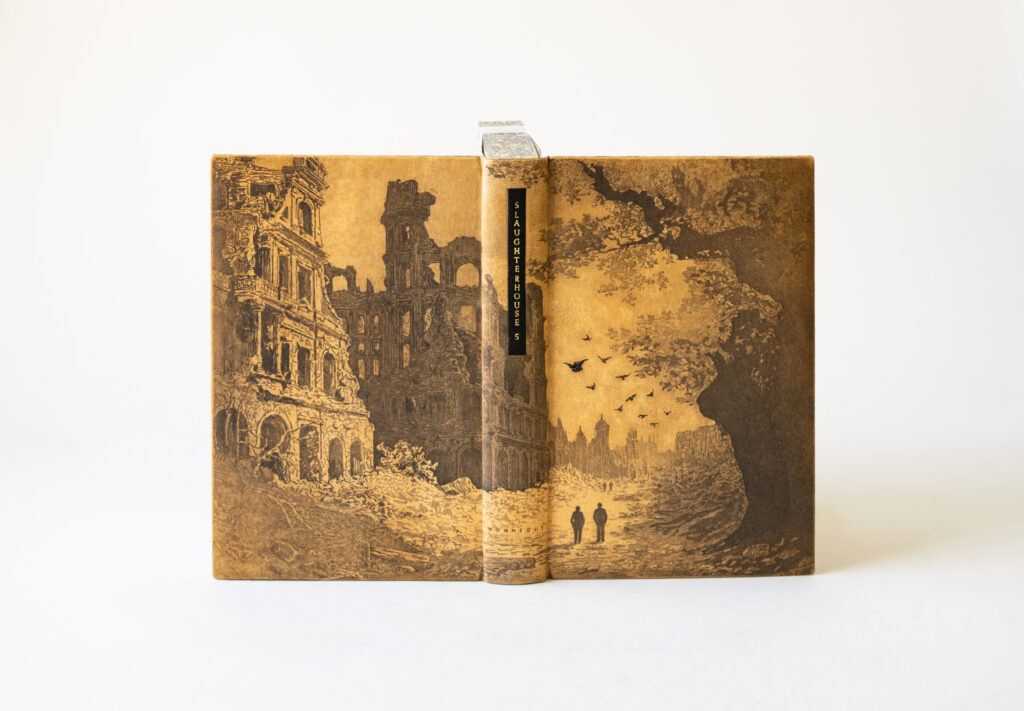
Jingjing covered her binding with a yellow-tan goatskin. Prior to covering she printed the skin through intaglio by running it through an etching press. As one can imagine, Jingjing had to experiment a lot to find the right approach to printing on leather. First was determining the right color for the leather. By printing on both an undyed and a yellow-tan skin, Jingjing found the latter provided the best range of tone. Next she had to figure out what type of ink to use and if any modifiers were required. She found that intaglio ink only sat on the surface of the leather and would not dry properly, so after consulting with some printmakers she landed on litho ink mixed with linseed oil. This allowed the outer layer of the ink to dry and in a more rapid time. Her tests took a minimum of 2 weeks to dry, but she found a faster drying method which reduced it to just 10 days.

The scene on the cover was illustrated by Jingjing using historical references of Dresden and depicts two figures in the foreground and two in the background, silently walking through the devastation. A flock of birds emerge overhead flying towards the foreground. The largest bird is adorned with a bead. The title is tooled in moon gold as Slaughterhouse 5 on a blind tooled black goatskin onlay. The author’s name is mixed into the rubble near the tail of the spine and tooled in carbon so that Vonnegut can blend into the environment as a nod to the text being self-referential.

The colorful endbands are sewn around a rectangular core to match the marbled fly leaves. All three edges are decorated with a coat of black acrylic paint sprinkled with moon gold. A single line is tooled at the board edge to mark the division between the turn-in and the black goatskin doublures. The interior side of the boards are adorned with different sunken intaglio prints on Rives BFK. Both prints showcase the moon in the background with a pathway leading figures towards it. While the front cover print is more otherworldly, the print on the back cover shows the figures approaching Dresden and seeing the destruction from afar. The marbled fly leaves were made by Jingjing during a workshop with Chena River.

Jingjing has been honing her skills as a printmaker for the past 9 years and intaglio is her preferred printing method. She attended the Rhode Island School of Design where she received her Master’s in 2023. It was at RISD where she was recommended to seek out NBSS from several professors as a way to explore bookbinding for the pursuit of making artist books. After graduation, Jingjing will be moving back to China where she plans to set-up a bindery space and offer a range of bookbinding services. She anticipates challenges ahead while establishing a practice in a place where the notion of bookbinding is scarce as well as supplies. However, Jingjing has already connected with another Chinese binder and is excited to bring her training back home. I am so impressed with Jingjing’s binding. She really let her printmaking skills sing without compromising the craftsmanship of the binding. I think her binding perfectly marries her years of experience as a printmaker with her newly acquired skills as a binder. I can’t wait to see what she does next!
– – –
I want to thank all the students for giving me some of their precious time in January, February and finally April to discuss their set books. And a big thanks to Jeff Altepeter, Head of the Bookbinding Department, for allowing me to steal away his students yet again. I also want to thank Barbara Rutkowski and Anna Doctor for photographing the students and their work. I couldn’t put this together without them. I look forward to this year after year and it was especially nice to be so familiar with everyone in the class. I wish all of them the best of luck as they navigate the early part of their career.
If you want more interviews from past classes check out the list here.